Early this year, a decision by organisers of the “Big Day Out” sparked public debate by banning people from bringing the Australian flag to the event-—on the eve of Australia Day. Event organisers said it was not a ban; they would just confiscate any flag that happened to surface-—be it a shirt, bandana or whatever. Australian Prime Minister John Howard expressed his outrage. “The proposition that the display of the Australian flag should ever be banned anywhere in Australia is offensive,” he said.
Having been raised in the United States of America, I was baffled by the entire discussion. Just to see if I could still say it, I placed my hand over my heart as I drove and chanted out the Pledge of Allegiance I said every day in primary school as the flag was put in place: “I pledge allegiance to the flag of United States of America, and to the republic for which it stands; one nation under God, indivisible, with liberty and justice for all.” Yep, it’s still there in the recesses of my mind.
Earlier this year I attended a church youth event with 13 nations represented—each country raised their flag and played their anthem. Amazingly, a group from New York had made the trip to New South Wales for the event. As they raised the flag of 50 stars in a blue sky, with stripes of red and white, I looked down to see one hand holding my hat, the other over my heart and was honestly surprised. How did that happen? I chided myself. I live in Australia now!
To ban the use of such an emblem of national pride is to devalue all those who have fought under that flag, literally, defending the principles upon which it is founded. I’ll admit it: Yanks are overpatriotic. We bleed red-white-and-blue blood. Imagine a Fourth of July without the flag! Even the fireworks burst in three colours. It was wired into us from the first day we went to school—you are American, this is your flag, be proud of both!
why symbols?
Symbols are important for identity and community. They tell me who I am and us who we are. Such is a flag and such is the cross. The flag connects us to our nation and the cross joins us to our King—a king who was lifted up on a cross to separate us from death. Thus the cross became the Christian symbol for victory. Death was swallowed up in the cross. The grave has lost its sting because Jesus absorbed sin’s penalty upon the cross of Calvary.
So crosses were placed on top of churches—where Christians meet; and at the front of sanctuaries-—where Christians kneel. But, due to the symbol being overused and misunderstood—to the point of worshipping the cross instead of the crucified Saviour—some Christians removed the cross from public display, but not from their hearts. The heart-to-heart connection to Jesus due to the victory on the cross is deep within the heart of every Jesus follower.
n The symbol of the cross was taken over by armies as they emblazoned it on their shields, swords and helmets. It became a fighting standard rather than a standard of freedom. Millions died facing the cross- on an approaching enemy soldier. Ironically, the entire point of the cross was that only one need die—God for humankind. The cross became a feared symbol, rather than a cherished one.
Today, the cross is again misrepresented as it is laced with diamonds, placed with pearls and worn as jewellery. The cross is the symbol of Christ’s victory, not the prize itself. As many pay a high price for a cross to wear around their neck, they pass by the invitation to shoulder the cross of Christ. “Take up your cross and follow Me,” He says. His is wooden. His is bloodstained.
Due to the misuse of the flag by extremist groups, there is occasional discomfort in using the flag for its intended purpose—as illustrated by “Big Day Out” organisers. The flag is the banner under which all fellow citizens stand in remembrance and national unity, as diverse as they may be. The flag is our common ground. To allow it to be disrobed and rebranded is unthinkable. And to disallow its general use is to admit such. This explains the Prime Minister’s outrage. The flag is the symbol of Australia and her people. It cannot be silenced.
the symbol of the cross
The same is true of the cross. It holds no power in and of itself. The cross was a device of torture and death, and was used by ancient governments to kill thousands of people. But Jesus, the God of the universe, willingly died upon a cross so we mortal creatures might be free to once again choose to follow Him. And thus the cross became a symbol of freedom rather than fear. Jesus turned death on its head, turned fear on its face and turned you and I toward Him. All on a cross.
n Christians love, honour and cherish Jesus. He is our Creator and our Recreator. He created us as His friends and designed this planet as our home. Then, when sin marred both the planet and the people, He returned to reclaim both. He died on the cross to pay fully the wages of sin-—death is no longer our master. And He returned to life to promise us life eternal with Him—the way He originally planned.
The death and resurrection of Jesus Christ are the foundation of all that Christians believe. Without them, our faith is nothing. Jesus died to give us life. Without Him death reigns.
This is what Christians remember at Easter. We honour His death and resurrection through the symbolic three-day weekend of Friday to Sunday in memory of the crucifixion, death and resurrection of Jesus Christ—our Saviour.
Unfortunately, like the flag and the cross, this memorial weekend has been derailed by society at large. The life-giving sacrifice of Jesus has been replaced by a large, furry bunny that lays chocolate eggs. Explain that.
I heard a local shop owner proudly declare, “We’re petitioning the Easter bunny. We’re getting signatures from adults who would like the Easter bunny to bring them alcohol rather than chocolate.”
The customer in front of me laughed and said, “I’d sign that!”
When it was my turn to talk to the shop owner, I said, “I’d be careful making such a request of the Easter bunny.”
“Why’s that?” she asked.
“Well, we know where the chocolate eggs come from,” I said with a grin. “Where do you think the alcohol is going to come from?”
Unfortunately, that’s where Easter has gone for many Australians. It’s just a long weekend for eating chocolate and drinking beer. Hardly a fitting memorial to anything.
Once again a symbol of something worthwhile and honourable has been relegated to the rubbish heap. But, we mustn’t let it.
n Reclaim Easter for Jesus. Spend time reflecting on the death and resurrection of the Saviour. Consider the new life He has given you. Spend quality time with your family. Go to church.
Don’t let society ban your beliefs. Governments protect their flag from abuse and encourage its rightful use. Christians should, likewise, lift high the cross and honour their Saviour, Jesus. Live a life of personal sacrifice and spiritual freedom. Honour the memory of the cross and the empty tomb.
“I pledge allegiance to Jesus Christ and to the life for which He stands. One eternal kingdom, with freedom and mercy for all.”

Sunday, May 20, 2007


Thursday, April 12, 2007
Margaret River

I was told that I MUST visit Margaret River while I am in Busselton.
So, today I drove the 45 minutes to see it.
It's a river. (a stagnate river, mind you... The sign said that it does flow occasionally... nice)
There is also a town much like any and every other town in Australia.

And some really strange toilets.
I couldn't take pictures in the other public toilet due to the disgusting invitations written on the walls...
More Busselton

I saw a dolphin from the beach in front of my little caravan!


And I saw this Manta Ray down the beach a ways...
This is the view from my patio. My caravan is literally "right on the beach!"
This place rocks!
Busselton WA Adventist Camp Ground


If you ever get to West Australia, you must visit Busselton.

 These pics are all taken from the beach in Busselton.
Friday, March 16, 2007
Thy Kingdom come
Some conversations change your perspective on an issue, your perception of a person, or your view of yourself. This one did all three.
I went in for a massage and came out with a message. The young massage therapist began my time on the table with a question, “What do you do, Dave?”
“I work for the Seventh-day Adventist Church.”
His response revealed a lot, “Is that a Catholic or a Christian church?”
Moments later I felt as lost in his world as he was in mine. “I’m a krumper,” he said.
“What’s a krumper?” I asked.
He explained that krumping is a form of dancing that “looks a lot like an epileptic fit the first time you see it.” He said he was a break dancer but broke his fibula landing a backflip. “I wont be able to do flips for at least a year,” he stated sadly. “So, I started krumping because it’s low impact.”
He then said something that really caught me off guard, “Krumping is a really religious dance.”
“Religious?” I questioned. Based on his earlier statement I wasn’t quite sure what “religious” actually meant to him.
“Yeah,” he said, “the guy that leads out in the krumping sessions at the skate park forms us into a circle and tells everyone to ‘bow your heads for a moment of respect.’ So, we bow our heads. He’s a big New Zealander, so everybody does what he says.”
“Respect?” I asked, “What are you respecting? The dance form? The leader?”
“We respect God!” he replied. “He full-on prays to Jesus—about the krumping session we’re about to start. When he finishes we take turns krumping. He even has his own style of krumping called ‘praise buck’ where he freezes with his hands together like he’s praying.” (Buck is the term used for a dancers personal style of krumping.)
The idea of praying before a dance session intrigued me. “What does he say when he prays?” I asked.
“He says pretty weird stuff, like, ‘Jesus, we know You made us in your image and made our bodies able to dance. We are getting buck for you Jesus! As we krump here on earth, we hope you and your angels will krump with us in Heaven.’ Then he says, ‘In Jesus name’ and everyone in the circle shouts ‘AMEN!’ It is an amazing sound to hear all those guys shouting ‘amen.’”
What was happening in that skate park as that dancer led in prayer? Was this evangelism? According to my masseur the krumping sessions attract druggies, homeless people, and teenagers who come to watch and krumpers who come to dance. And they all hear the prayer. I asked, “Do his prayers make you think? Have you ever asked about Jesus?”
“Nah, not yet,” the young krumper replied, “but it does make me wonder. I respect him a lot and he believes in Jesus. It’s cool. Yeah, one day I’m gonna ask him what it’s all about.”
He fired another question at me, “Hey, you being a Christian, is it alright to pray like that?”
My reply took me by surprise, “In the Bible King David ‘danced before the Lord.’ So, I guess the ‘krumping for Jesus’ thing is okay. And, when Christians are about to worship Jesus in church—we do that by singing—the worship leader will often pray, ‘Dear Jesus, as we sing here on earth, we hope you and your angels will sing with us in Heaven.’ So, yeah, I guess it’s alright. But, I know I couldn’t do it.”
“Why not?”
“Because I can’t dance!”
Later, sitting at my computer, I googled “krump” and discovered it is an acronym for Kingdom Radically Uplifted Mighty Praise. The krumping dance form emerged in South Central Los Angeles as a nonviolent way of releasing aggression. Now it’s an internationally recognised dance form.
Bringing God’s kingdom to people often happens in ways unexpected by the majority of believers. Jesus told parables (literally ‘near bringers’). Martin Luther translated the Bible. Charles Wesley wrote hymns. Ellen White penned books. Each using the media and the means of their day.
I was challenged by that conversation. Not to become a krumper, but to withhold judgement of what I do not understand, to value those who do what I am unable to do and to use my skills to take God’s kingdom to the people I can influence.
I went in for a massage and came out with a message. The young massage therapist began my time on the table with a question, “What do you do, Dave?”
“I work for the Seventh-day Adventist Church.”
His response revealed a lot, “Is that a Catholic or a Christian church?”
Moments later I felt as lost in his world as he was in mine. “I’m a krumper,” he said.
“What’s a krumper?” I asked.
He explained that krumping is a form of dancing that “looks a lot like an epileptic fit the first time you see it.” He said he was a break dancer but broke his fibula landing a backflip. “I wont be able to do flips for at least a year,” he stated sadly. “So, I started krumping because it’s low impact.”
He then said something that really caught me off guard, “Krumping is a really religious dance.”
“Religious?” I questioned. Based on his earlier statement I wasn’t quite sure what “religious” actually meant to him.
“Yeah,” he said, “the guy that leads out in the krumping sessions at the skate park forms us into a circle and tells everyone to ‘bow your heads for a moment of respect.’ So, we bow our heads. He’s a big New Zealander, so everybody does what he says.”
“Respect?” I asked, “What are you respecting? The dance form? The leader?”
“We respect God!” he replied. “He full-on prays to Jesus—about the krumping session we’re about to start. When he finishes we take turns krumping. He even has his own style of krumping called ‘praise buck’ where he freezes with his hands together like he’s praying.” (Buck is the term used for a dancers personal style of krumping.)
The idea of praying before a dance session intrigued me. “What does he say when he prays?” I asked.
“He says pretty weird stuff, like, ‘Jesus, we know You made us in your image and made our bodies able to dance. We are getting buck for you Jesus! As we krump here on earth, we hope you and your angels will krump with us in Heaven.’ Then he says, ‘In Jesus name’ and everyone in the circle shouts ‘AMEN!’ It is an amazing sound to hear all those guys shouting ‘amen.’”
What was happening in that skate park as that dancer led in prayer? Was this evangelism? According to my masseur the krumping sessions attract druggies, homeless people, and teenagers who come to watch and krumpers who come to dance. And they all hear the prayer. I asked, “Do his prayers make you think? Have you ever asked about Jesus?”
“Nah, not yet,” the young krumper replied, “but it does make me wonder. I respect him a lot and he believes in Jesus. It’s cool. Yeah, one day I’m gonna ask him what it’s all about.”
He fired another question at me, “Hey, you being a Christian, is it alright to pray like that?”
My reply took me by surprise, “In the Bible King David ‘danced before the Lord.’ So, I guess the ‘krumping for Jesus’ thing is okay. And, when Christians are about to worship Jesus in church—we do that by singing—the worship leader will often pray, ‘Dear Jesus, as we sing here on earth, we hope you and your angels will sing with us in Heaven.’ So, yeah, I guess it’s alright. But, I know I couldn’t do it.”
“Why not?”
“Because I can’t dance!”
Later, sitting at my computer, I googled “krump” and discovered it is an acronym for Kingdom Radically Uplifted Mighty Praise. The krumping dance form emerged in South Central Los Angeles as a nonviolent way of releasing aggression. Now it’s an internationally recognised dance form.
Bringing God’s kingdom to people often happens in ways unexpected by the majority of believers. Jesus told parables (literally ‘near bringers’). Martin Luther translated the Bible. Charles Wesley wrote hymns. Ellen White penned books. Each using the media and the means of their day.
I was challenged by that conversation. Not to become a krumper, but to withhold judgement of what I do not understand, to value those who do what I am unable to do and to use my skills to take God’s kingdom to the people I can influence.
Sunday, February 11, 2007
Linda's baptism
We have been awaiting this special day for over a year!
Linda is blessed to live on the shore of Seven Mile Beach and was able to have a large group of friends attend her baptism and then stay for a BBQ afterwards.
Here are a few photos of the special moment!
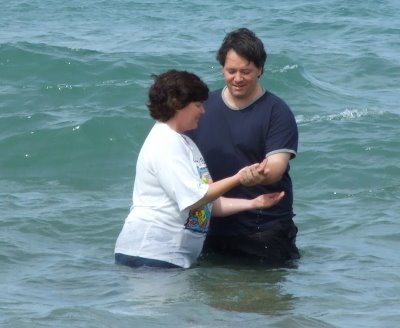
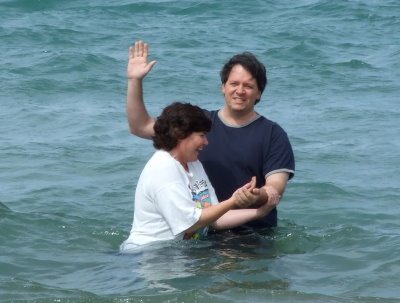


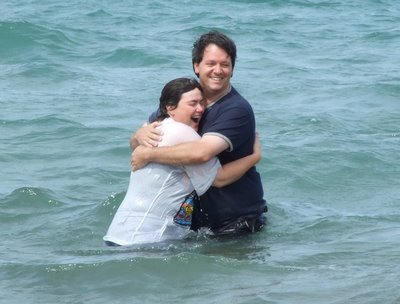
I will never forget what Linda said the first day we studied the Bible together.
She had been invited to come along by her work mate Sarah-Jayne, who was preparing for baptism. Linda was interested in what Seventh-day Adventists believed and decided to join us although she was suspicious of churches.
Having been introduced to Jesus some years earlier, Linda was told that Jesus was all she needed to be a Christian. Churches, she was told, may once have had contact with God. But now they were adrift at sea, having lost their way. She accepted Jesus and followed Him as best she could by listening to Christian music and reading the Bible.
So it was with some trepidation that Linda entered the church hall and sat in a sunlit corner with Sarah-Jayne and me. It wasn’t long into the conversation that Linda put her worries into words. Her eyes wandered around the brick room and in her quiet voice she reflected, “It just feels like churches put God in a box.”
The idea of having God in a box was a familiar one to me, but I had never considered church buildings as a visual representation of the limits we put on God. Was this how the world saw the church? Are we the ones with a small God? Are we naively keeping God locked in our jewellery boxes while the rest of humanity allows Him to roam free—unhindered and undefined?
Is this why denominations seem to race to build bigger and better churches—to demonstrate that my God is bigger than your God? Are the differing denominations like an after-school fight—churches facing up to each other with taunts and fists while the world stands by watching in amused disinterest?
Linda continued: “I find God in nature. I see Him in the bush. I see God at the beach. I don’t like putting God in a box. And sometimes I wonder, does God really limit Himself to the boxes we build for him?” Her eyes again surveyed the church structure, “Does He even enter them at all?”
My mind, which often wanders off the beaten path, visualised Aladdin’s Genie (in the Disney story) shouting to declare his “PHENOMENAL COSMIC POWERS!” before stuffing himself into his tiny lamp and whimpering, “itty, bitty living space!” Was this our God—a divine eternal being, stuffed into a box we rub once a week?
To Linda’s credit, she kept coming into the box, into my church, to hear me talk about my God. Sometimes it was about the God of the box; sometimes it was about the God outside the box. She came. She listened. She learned. And she looked to see if her very big God was in any way present in our little church.
Linda was invited to attend Jason’s small group. There she discovered something. The church wasn’t made of bricks and walls. The church was hearts and people. God’s church was God’s people. The walls just provided a place to meet, out of the weather, to experience community, friendship, family and to worship—together—as the people of God.
Linda had discovered the church. The true church. She saw past the walls and into the heart of the place—and there she saw the heart of God—His people. In her small group Linda discovered something about God’s people that she could relate to —really relate to! These people had questions. More questions than answers. Questions about life. Questions about God. Questions with answers. Questions without answers. Questions that led to vigorous discussion. Questions that led to thoughtful silence. Linda and her questions about God, and the box, had found a home.
I told this story one Sabbath afternoon a few weeks ago while standing on a beach as Linda’s small group, family and friends pressed around her. We all stood together on the sand as the wind whipped through our hair and the waves pounded at our heels.
After the story was finished, Linda and I turned and walked away from the crowd—into the surf. And there the story began anew.
Congratulations, Linda! May you continue to huddle against the elements of this world with your church family and may you never stop thinking outside the box.
Linda is blessed to live on the shore of Seven Mile Beach and was able to have a large group of friends attend her baptism and then stay for a BBQ afterwards.
Here are a few photos of the special moment!

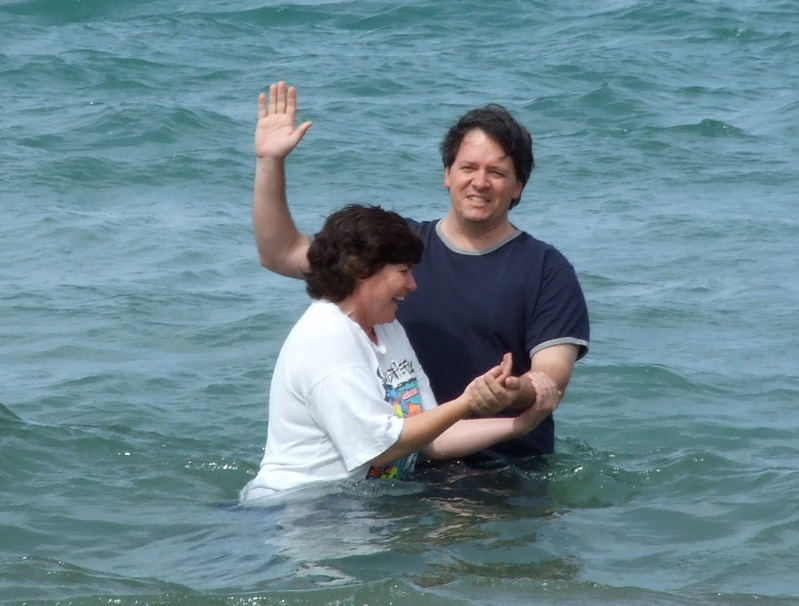
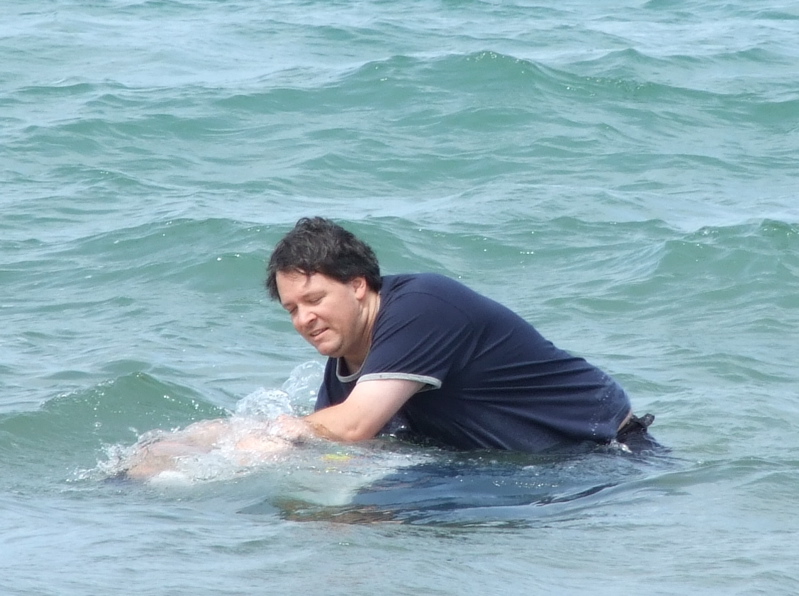

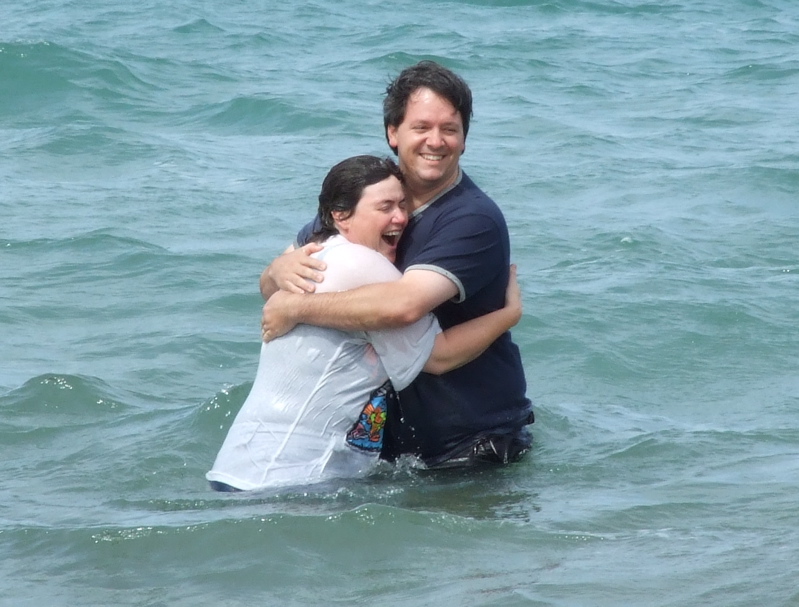
I will never forget what Linda said the first day we studied the Bible together.
She had been invited to come along by her work mate Sarah-Jayne, who was preparing for baptism. Linda was interested in what Seventh-day Adventists believed and decided to join us although she was suspicious of churches.
Having been introduced to Jesus some years earlier, Linda was told that Jesus was all she needed to be a Christian. Churches, she was told, may once have had contact with God. But now they were adrift at sea, having lost their way. She accepted Jesus and followed Him as best she could by listening to Christian music and reading the Bible.
So it was with some trepidation that Linda entered the church hall and sat in a sunlit corner with Sarah-Jayne and me. It wasn’t long into the conversation that Linda put her worries into words. Her eyes wandered around the brick room and in her quiet voice she reflected, “It just feels like churches put God in a box.”
The idea of having God in a box was a familiar one to me, but I had never considered church buildings as a visual representation of the limits we put on God. Was this how the world saw the church? Are we the ones with a small God? Are we naively keeping God locked in our jewellery boxes while the rest of humanity allows Him to roam free—unhindered and undefined?
Is this why denominations seem to race to build bigger and better churches—to demonstrate that my God is bigger than your God? Are the differing denominations like an after-school fight—churches facing up to each other with taunts and fists while the world stands by watching in amused disinterest?
Linda continued: “I find God in nature. I see Him in the bush. I see God at the beach. I don’t like putting God in a box. And sometimes I wonder, does God really limit Himself to the boxes we build for him?” Her eyes again surveyed the church structure, “Does He even enter them at all?”
My mind, which often wanders off the beaten path, visualised Aladdin’s Genie (in the Disney story) shouting to declare his “PHENOMENAL COSMIC POWERS!” before stuffing himself into his tiny lamp and whimpering, “itty, bitty living space!” Was this our God—a divine eternal being, stuffed into a box we rub once a week?
To Linda’s credit, she kept coming into the box, into my church, to hear me talk about my God. Sometimes it was about the God of the box; sometimes it was about the God outside the box. She came. She listened. She learned. And she looked to see if her very big God was in any way present in our little church.
Linda was invited to attend Jason’s small group. There she discovered something. The church wasn’t made of bricks and walls. The church was hearts and people. God’s church was God’s people. The walls just provided a place to meet, out of the weather, to experience community, friendship, family and to worship—together—as the people of God.
Linda had discovered the church. The true church. She saw past the walls and into the heart of the place—and there she saw the heart of God—His people. In her small group Linda discovered something about God’s people that she could relate to —really relate to! These people had questions. More questions than answers. Questions about life. Questions about God. Questions with answers. Questions without answers. Questions that led to vigorous discussion. Questions that led to thoughtful silence. Linda and her questions about God, and the box, had found a home.
I told this story one Sabbath afternoon a few weeks ago while standing on a beach as Linda’s small group, family and friends pressed around her. We all stood together on the sand as the wind whipped through our hair and the waves pounded at our heels.
After the story was finished, Linda and I turned and walked away from the crowd—into the surf. And there the story began anew.
Congratulations, Linda! May you continue to huddle against the elements of this world with your church family and may you never stop thinking outside the box.
Carlton River B&B - Hobart's best bed and breakfast
 This weekend while we were in Tassie for Linda's baptism (see above post) we had one of our best lodging experiences ever!
Jenny and I decided to go for a B&B in the country. What we found was absolute magic! We can't imagine a more romantic get away. The host couple were wonderful people and provided delicious breakfasts each morning.
We had a very nice room with ensuite and the common area was very comfortable with stunning views of the Carlton river.
Have a look at the pics, and if you ever go to Hobart . . . now you know where to stay!
The two nights, for the two of us with breakfasts was only $240. Absolutely amazing!
We got the camera out and took a few dozen photos on the two mornings we were there.

The river has so much character with it's rocky shore, treelined verge and grassy hills.

It was such a beautiful location with riverviews that always include Tasmania's regal black geese. Here, also, you can see the neighbours (across the river) sheep having their morning graze. Just moments later they all wandered up the hill and down the other side.

Sunday morning I rose early and waited for the sun to peek over the hills. What a reward awaited me!
 This photo was Jenny's inspired creation. The windmill and agapanthas are in the front yard of the B&B.
Sunday, February 04, 2007





Wednesday, January 31, 2007
Happy Feet speak where words cannot
Here's an idea - go watch the movie Happy Feet. The lead character, a little penguin named Mumble, changes the fishing habits among humans through his unique gift of tap dancing. Does that sound impossible? It's one of the things I love about the movie. He doesn't have a voice - can't sing - and is ignored by his own tribe of penguins - he is Mumble. And yet, when he stands before humans and wants to get their attention he falls back on what he does naturally - he dances. And it is so interesting and unique that he is tagged and followed back to his tribe. And when he returns and gets his message across - they dance, all of them. And it saved them, because it caused a furor among the humans who came to watch.
What is unique about you, your family, friends or faith? How can you dance it out? Go be yourself in front of the world - bring them to your door and then teach your people to dance too.
What a movie! Makes me want to dance.
What is unique about you, your family, friends or faith? How can you dance it out? Go be yourself in front of the world - bring them to your door and then teach your people to dance too.
What a movie! Makes me want to dance.
Smelling the truth
I am at meetings in Sydney and sharing a room (incidentally with a name amazingly close to mine - David Edgar!)...
This morning, while I packed my bag to return home tonight he said, "Do you smell something burning?" I had noticed that he was purposefully wandering around the room looking for something. Now I knew what he was concerned about - something smelled like fire.
I don't have a sense of smell. Never have. Born broken! Anyway, I don't smell fire, I see it. And there wasn't any to see. I said, "No, I don't smell anything." (Which is more true than when most people say it!) Then he discovered that the bedsheet that I had taken off my bed and placed near the door (on the stove) was being burnt. One of the knobs had been nudged - probably as I put the sheet on the stove - and it was on the lowest setting. The sheet and tea towel on the burner were imprinted with scorched rings. His nose had been right. Something certainly was burning!
A discussion about my lack of functioning olfactory senses then ensued. It is true - I have never been able to smell. And yes, I can taste food. Does it taste the same? I wouldn't know. Food has always tasted without being smelled for me. And I know what I'm eating. I can tell when milk is going off before it smells off. But most milk chocolate tastes the same to me - expensive or cheap - it all tastes like milk chocolate. But I like dark chocolate - the darker the better. I like the bitterness. I like coffee strong without sugar. something about the bitterness is delicious to me. Is this experience shared by the smelling community? Not sure.
Any way, back to the burner. My roommate told me that he has always had an overactive olfactory neve. The smell of burnt linen caused him to sneeze! Someone with a name so close to mine has an awareness of scents so different than mine. And that one little difference makes his experience of the world so extremely different than mine. He smells everything. I smell nothing. He reacts violently to things that I would walk right by without even noticing.
What stops you? What draws your attention? What are you atuned too? What do you walk right by? What's on fire in your life? Do you smell it? What do you avoid because it's too strong for your senses? What are you drawn too? What affect do you have on the things that bother/shock you? How are you involved in changing your local picture - your environment? What can you do?
This morning, while I packed my bag to return home tonight he said, "Do you smell something burning?" I had noticed that he was purposefully wandering around the room looking for something. Now I knew what he was concerned about - something smelled like fire.
I don't have a sense of smell. Never have. Born broken! Anyway, I don't smell fire, I see it. And there wasn't any to see. I said, "No, I don't smell anything." (Which is more true than when most people say it!) Then he discovered that the bedsheet that I had taken off my bed and placed near the door (on the stove) was being burnt. One of the knobs had been nudged - probably as I put the sheet on the stove - and it was on the lowest setting. The sheet and tea towel on the burner were imprinted with scorched rings. His nose had been right. Something certainly was burning!
A discussion about my lack of functioning olfactory senses then ensued. It is true - I have never been able to smell. And yes, I can taste food. Does it taste the same? I wouldn't know. Food has always tasted without being smelled for me. And I know what I'm eating. I can tell when milk is going off before it smells off. But most milk chocolate tastes the same to me - expensive or cheap - it all tastes like milk chocolate. But I like dark chocolate - the darker the better. I like the bitterness. I like coffee strong without sugar. something about the bitterness is delicious to me. Is this experience shared by the smelling community? Not sure.
Any way, back to the burner. My roommate told me that he has always had an overactive olfactory neve. The smell of burnt linen caused him to sneeze! Someone with a name so close to mine has an awareness of scents so different than mine. And that one little difference makes his experience of the world so extremely different than mine. He smells everything. I smell nothing. He reacts violently to things that I would walk right by without even noticing.
What stops you? What draws your attention? What are you atuned too? What do you walk right by? What's on fire in your life? Do you smell it? What do you avoid because it's too strong for your senses? What are you drawn too? What affect do you have on the things that bother/shock you? How are you involved in changing your local picture - your environment? What can you do?
Sunday, December 03, 2006
Geelong Church Camp
This weekend I presented "Evangelism that Works" at Howqua to the Geelong church members. I also presented a new bit that I have been working on called "Nurture for Growth" that targets Christians commiting to grow other Christians.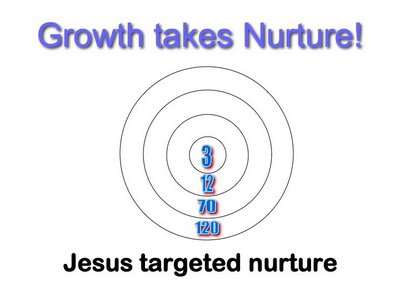
The basic principle is that we grow Christians by nurturing them.
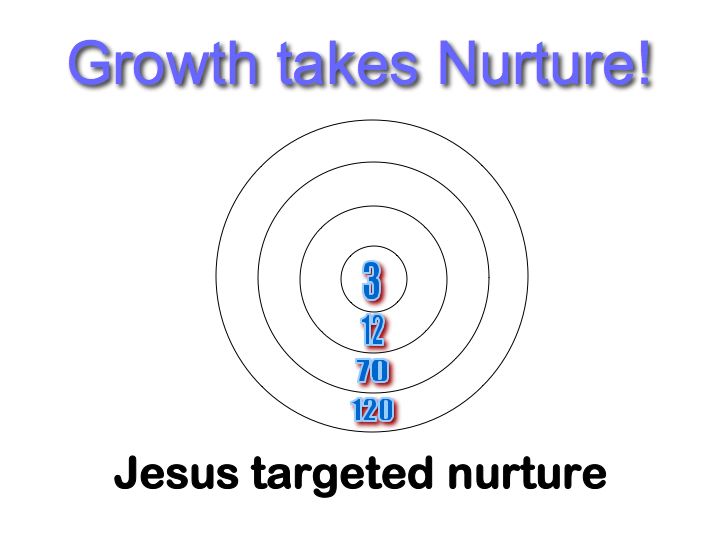
Jesus demonstrated this by targeting his ministry in levels of involvement. Time that he spent with the 120 also included the inner circles (70, 12, 3).
As he ministered to the 70 and the 12 the 3 were there. The three were the most trained, most loved, most nurturered. It was common for Jesus to limit his audience and when he focused on the 12, the 70 and 120 may not have been there and at times were specifically not invited. And, at times Jesus chose to seperate the 3 (Peter, James and John) from the the 12 for a special time of training and nurture. These 3 were Jesus' "Nurture Group" as I call them.
Jesus did not appologise for this focused nurture. He saw it as neccesary and chose to specifically involve these three in high points of his spiritual journey - they were at the Mount of transfiguration (Matt 171-3), at the raising for Jairus' daughter (Mark 5:22-42) and in the Garden of Gethsmene (Mark 14:32-36). At each of these times Jesus specifically called these three out of the twelve and instructed the other 9 to stay behind. He made it clear that he was pouring special time and training into these three.
We should do likewise. Here is my basic framework for healthy Nurture.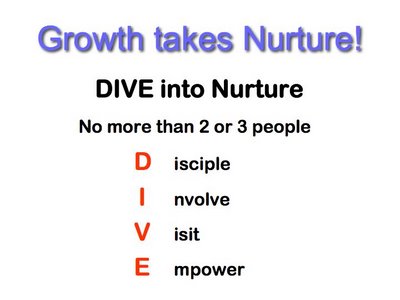
I suggested to the group that: We must NURTURE THE FUTURE
New Christians don’t grow on trees
Jesus plants them, Disciples nurture them
You only have so much to give
Choose to nurture maturely
Select 1, 2 or 3 people to nurture
Nurture them generously (time, energy, love)
I suggested that we build nurture groups one person at a time using the following strategy:
Get to know them
Find their passion
Get involved in their passion
Give them training
Create a safe place for them to thrive
Form them into a team
I concluded with 2 questions to get you started nurturing:
Who: Who can I ask to nurture me?
Who can I nurture?
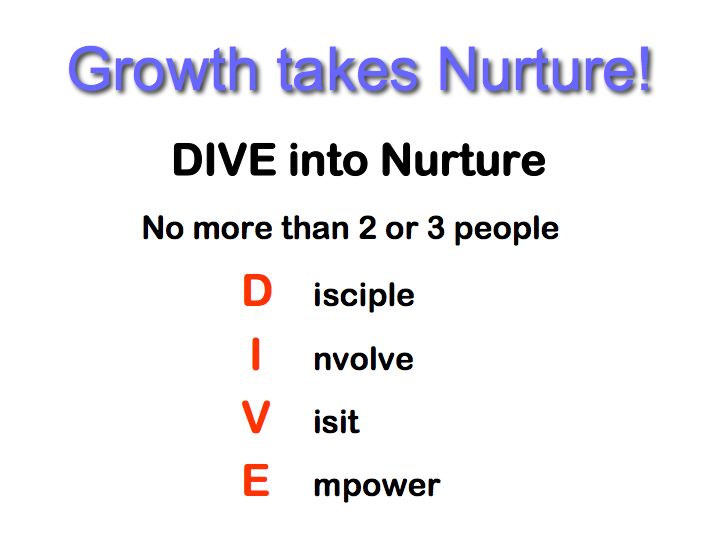
How: How can I disciple them?
How can I invlove them?
How can I visit them?
How can I empower them?
This framework and explaination is still in the formation stages in my mind, but I have decided to start presenting and refining it through getting the thoughts and reflections of the listeners. This process of presentation and reflection has helped me hone the "Evangelism that Works" presentation to, by far, the most practical and helpful sermon I have in my arsenal!
God is good!
The basic principle is that we grow Christians by nurturing them.
Jesus demonstrated this by targeting his ministry in levels of involvement. Time that he spent with the 120 also included the inner circles (70, 12, 3).
As he ministered to the 70 and the 12 the 3 were there. The three were the most trained, most loved, most nurturered. It was common for Jesus to limit his audience and when he focused on the 12, the 70 and 120 may not have been there and at times were specifically not invited. And, at times Jesus chose to seperate the 3 (Peter, James and John) from the the 12 for a special time of training and nurture. These 3 were Jesus' "Nurture Group" as I call them.
Jesus did not appologise for this focused nurture. He saw it as neccesary and chose to specifically involve these three in high points of his spiritual journey - they were at the Mount of transfiguration (Matt 171-3), at the raising for Jairus' daughter (Mark 5:22-42) and in the Garden of Gethsmene (Mark 14:32-36). At each of these times Jesus specifically called these three out of the twelve and instructed the other 9 to stay behind. He made it clear that he was pouring special time and training into these three.
We should do likewise. Here is my basic framework for healthy Nurture.
I suggested to the group that: We must NURTURE THE FUTURE
New Christians don’t grow on trees
Jesus plants them, Disciples nurture them
You only have so much to give
Choose to nurture maturely
Select 1, 2 or 3 people to nurture
Nurture them generously (time, energy, love)
I suggested that we build nurture groups one person at a time using the following strategy:
Get to know them
Find their passion
Get involved in their passion
Give them training
Create a safe place for them to thrive
Form them into a team
I concluded with 2 questions to get you started nurturing:
Who: Who can I ask to nurture me?
Who can I nurture?
How: How can I disciple them?
How can I invlove them?
How can I visit them?
How can I empower them?
This framework and explaination is still in the formation stages in my mind, but I have decided to start presenting and refining it through getting the thoughts and reflections of the listeners. This process of presentation and reflection has helped me hone the "Evangelism that Works" presentation to, by far, the most practical and helpful sermon I have in my arsenal!
God is good!
Subscribe to:
Posts (Atom)
Dave Edgren ~ Story: Teller, Author, Trainer ~
BOOK DAVE NOW! Dave Edgren is passionate about creating a values-based storytelling culture. In his engaging and often hilarious way,...

-
.jpeg) As a regular participant in a weekly Bible Study Group (called "Sabbath School" in the Adventist denomination) and having served a...
As a regular participant in a weekly Bible Study Group (called "Sabbath School" in the Adventist denomination) and having served a... -
.jpeg) More Bible Study and Sabbath School Resources Introduction Sabbath School was the backbone of the early Adventist church. As a people of the...
More Bible Study and Sabbath School Resources Introduction Sabbath School was the backbone of the early Adventist church. As a people of the...